How’d you sleep last night?
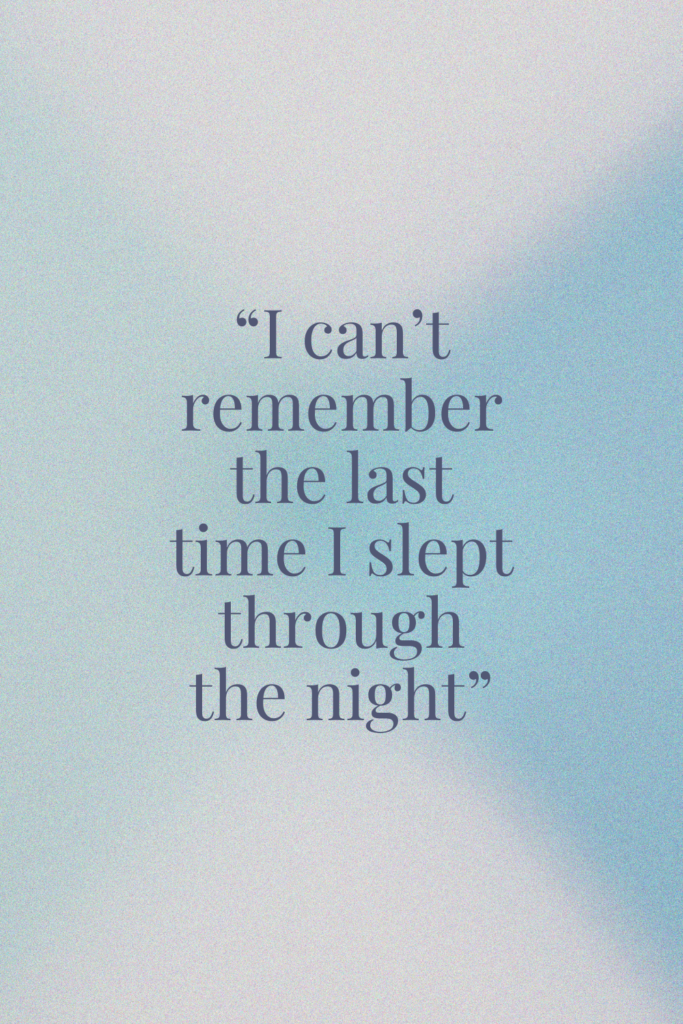
I used to be a great sleeper. (And I promise this post is worth the read if sleep is in the past tense for you too.)
I say that looking back — because sleep wasn’t something I ever had to think about.
I went to bed, my head hit the pillow, and within ten minutes I was out.
I slept through the night.
I woke up, got out of bed, and started my day.
My brain clicked on and I was in go-mode.
I felt good.
Then in 2021, something shifted.
I could still fall asleep without any problem — but I started waking up at 3 a.m.
At first I’d roll over and fall back asleep pretty quickly.
But over time, I started lying there for hours.
Some mornings I’d finally drift off around 6 and sleep until 9 (my kids were homeschooling post-COVID, so I had that luxury).
Most days, I just dragged myself through the day starting at 6 after staring at the ceiling for those last three hours.
Coffee got me going.
Workouts seemed to energize me.
But by 2 p.m. I was done.
Everything started to annoy me.
I had brain fog.
I was irritable, moody, snappy — and honestly, I didn’t love my attitude.
I was annoyed with myself.
The longer it went on, the more dependent I became on coffee.
I switched to mushroom coffee trying to cut back on caffeine.
I started craving sugar.
The sleep deprivation showed up on my face and in my eyes.
I looked as tired as I felt.
It took a few years of trial, error, and research, but I’m happy to tell you…
I’m a great sleeper again.
Even in menopause.
And you can be too.
But here’s the biggest lesson I learned:
You can’t start thinking about sleep at 10 p.m.
How you sleep is a reflection of your lifestyle.
The choices you make from 6 a.m. to 6 p.m. have a far bigger impact on your sleep than anything you do right before bed.
That’s what this series is about.
Over the next few days I’m going to help you understand:
- how your circadian rhythm sets the stage for sleep
- why blood sugar is behind so many 3 a.m. wake-ups
- how a stuck nervous system blocks deep rest
- and how modern stress quietly steals your nights
Not with complicated protocols — but with small, realistic shifts that actually work in real life.
Because sleep isn’t something to force.
It’s something to support throughout the day.
In midlife, four things tend to converge and disrupt that rhythm:
🔹 1. Circadian rhythm gets confused
Your circadian clock lives in a tiny region of the brain called the suprachiasmatic nucleus (SCN) — and it’s influenced by estrogen. As estrogen changes, that clock loses some of its precision, so light, stress, and late screens have a much bigger impact than they used to. You just can’t get away with what you used to if you want to sleep well and recover.
🔹 2. Blood sugar instability
When glucose dips overnight, your body releases cortisol and adrenaline to rescue you — which often feels like waking up wide awake at 3 a.m. As estrogen declines in midlife, your cells become less sensitive to insulin and muscles don’t store glucose as easily, so the same meals you’ve eaten for years can suddenly lead to nighttime drops. Your body isn’t failing — it’s responding to new metabolic rules. Blood sugar used to be a quiet background process; now it has a microphone.
🔹 3. Nervous system stuck in “on” — and why midlife makes it louder
If your system never truly downshifts during the day, it won’t downshift at night — rest requires biological safety, not willpower. In midlife, stress hormones and sex hormones rely on many of the same raw materials, like DHEA, so years of running in survival mode can leave fewer resources to support calm, restorative rhythms. The result is a nervous system that reacts faster, stays activated longer, and has a harder time finding “off,” which often shows up as racing thoughts or light, fragmented sleep. This is why calming your nervous system during the day is more powerful than any bedtime routine. We’ll unpack simple ways to rebuild that safety in Email 3.
🔹 4. Modern stress & toxic load — and what’s happening around 3 a.m.
Your liver does much of its detox and hormone processing in the early morning hours, often peaking around 1–3 a.m.When it’s overloaded — from stress hormones, alcohol, medications, environmental chemicals, or simply the demands of midlife hormone shifts — the body can trigger a cortisol surge to keep those processes moving. That surge can feel like a sudden, alert wake-up with a busy mind or even mild anxiety. When we reduce the load, support the liver, and calm the nervous system, we allow the sleep cycle to finish its natural job.
📌 What This Series Is Really About
Over the next few days I’m going to break these down with science + simple tools so you can choose a few things to tweak in your routine — things that actually work over time.
My goal isn’t to overwhelm you.
It’s to give you real, usable actions — not just checklists.
✨ What This Really Means for You
Sleep isn’t optional.
It’s foundational.
If your sleep is disrupted, chances are you’re also experiencing:
✔ stubborn weight gain
✔ low energy throughout the day
✔ anxiety or irritability
✔ slowed metabolism
✔ trouble focusing
✔ slower recovery from workouts
And here’s the thing:
No amount of HRT, peptides, workouts, or nutrition plans will work well if your sleep foundation is weak.
Sleep supports your hormones, your metabolism, your energy, your brain — but it doesn’t happen in isolation.
There’s a rhythm you can rebuild… and I’ll show you how.
A Few Tools I’ve Actually Used
While we’re rebuilding these rhythms, I want you to have a few supports that have genuinely helped me — and helped countless clients — when they have to function day to day while waiting for these lifestyle shifts to kick in and enhance their sleep. Because it does take time and I want you to feel functional on the way to feel amazing.
✨ NMN (Nicotinamide Mononucleotide)
NMN supports NAD+, the molecule that lets your cells actually make energy instead of borrowing it from stress hormones. For me, it’s delivered smoother morning energy than coffee ever did — and that daytime stability translates into calmer nights and fewer 3 a.m. wake-ups.
✨ Creatine for Cognitive Function
Creatine isn’t just for muscle — studies show it helps preserve cognitive performance when sleep is fragmented or insufficient.*
That means less “brain fog” and better mental clarity during the day while you retrain your sleep.
(For example: creatine supplementation has been shown to improve short-term memory and reduce mental fatigue when sleep deprived in controlled studies.)
I’m very intentional about what I recommend. This formula comes from a research-driven longevity company, and every batch is 3rd-party tested for purity and potency (like all the supplements I recommend) — which matters when we’re talking about nervous system and brain support.
It’s built around three ingredients with decades of research behind them:
✔ Magnesium glycinate – a highly absorbable form of magnesium that supports muscle relaxation, GABA activity, and the transition into deeper sleep stages without the laxative effect of other forms. Magnesium is also involved in over 300 enzymatic reactions tied to stress resilience.
✔ L-Theanine – an amino acid from green tea shown to increase alpha brain waves — the same pattern seen in meditation — helping the mind settle without sedation or next-day grogginess.
✔ Apigenin – a gentle botanical compound that interacts with GABA receptors to take the “edge” off the nervous system and support natural melatonin signaling.
Together, the goal isn’t to knock you out — but to retrain the system:
• ease nighttime tension
• support true restorative sleep cycles
• foster calm nervous system recovery
• rebuild natural circadian rhythms
Think of it as a bridge tool while you rebuild the daytime habits that make sleep possible.
It’s not a sedative.
It’s a bridge — something that cues your system that rest is safe while the lifestyle changes take hold.
We’ll talk more about these in detail later in this series — when it makes sense contextually — not just listed as products. But if you one resonates with you “coachcalie” gets you a discount. If you have questions just hit reply. I’m always here.
What You Can Expect Next
Tomorrow we’re going to start with something many women miss:
👉 How blood sugar & circadian rhythm can literally wake you up in the middle of the night
… and what you can do today to start shifting that pattern.
📨 Let’s Connect
I’m not here to simply talk at you…I want to talk with you. So hit reply and tell me
what time you usually wake up?
what you’ve tried already?
what feels most frustrating?
I read every reply, and your words help shape the next level of information I share.
Remember, your sleep didn’t suddenly betray you — it’s been shaped by the way modern life asks us to live. Most of us were never taught how to protect rest in a world of alarms, screens, caffeine, constant stress, and artificial light. Those habits quietly teach the nervous system to stay alert instead of relaxed.
But the same nervous system that learned those patterns can learn new ones.
And when your habits begin to support your biology, sleep returns — even in midlife, even in menopause.
Here for you,
— Calie
Ready to keep learning…head to the next post in this series here.
